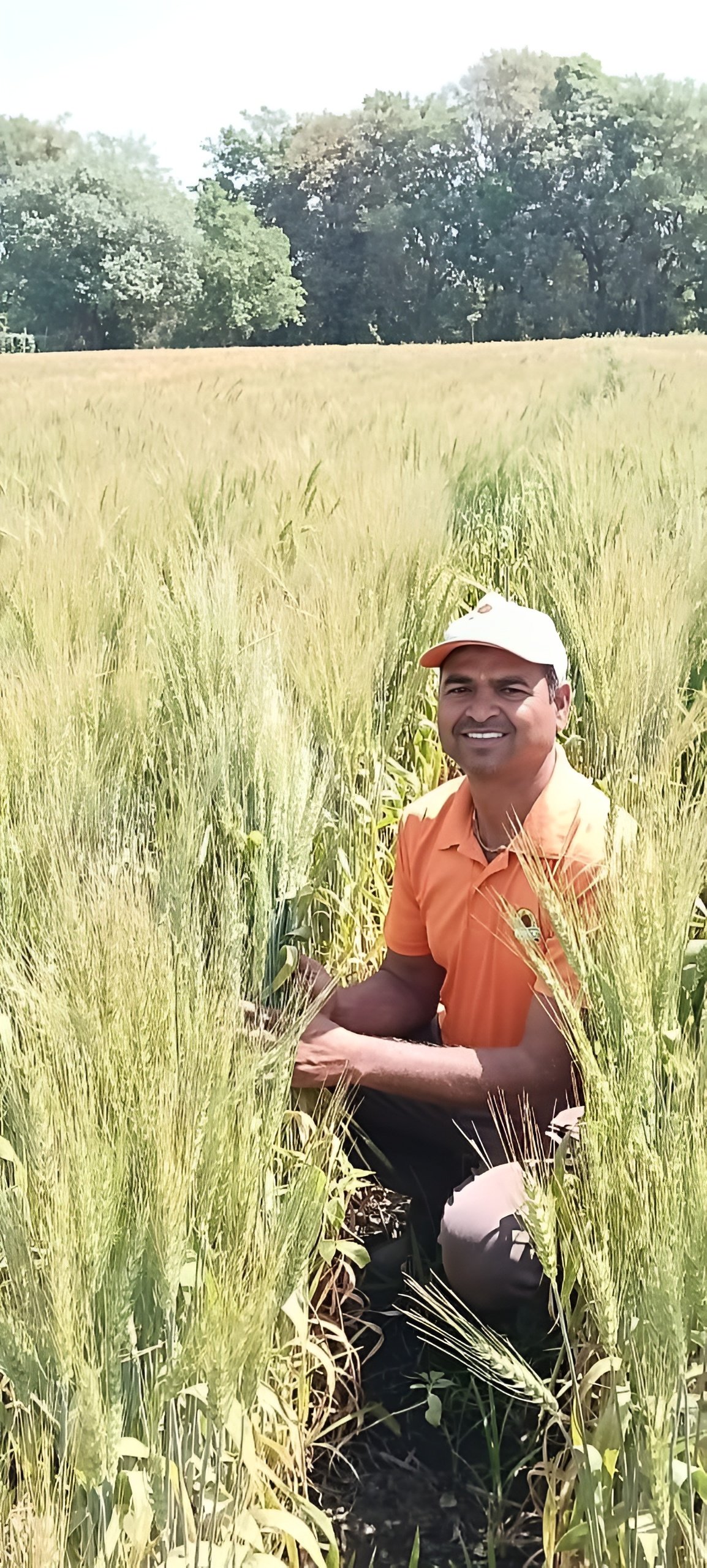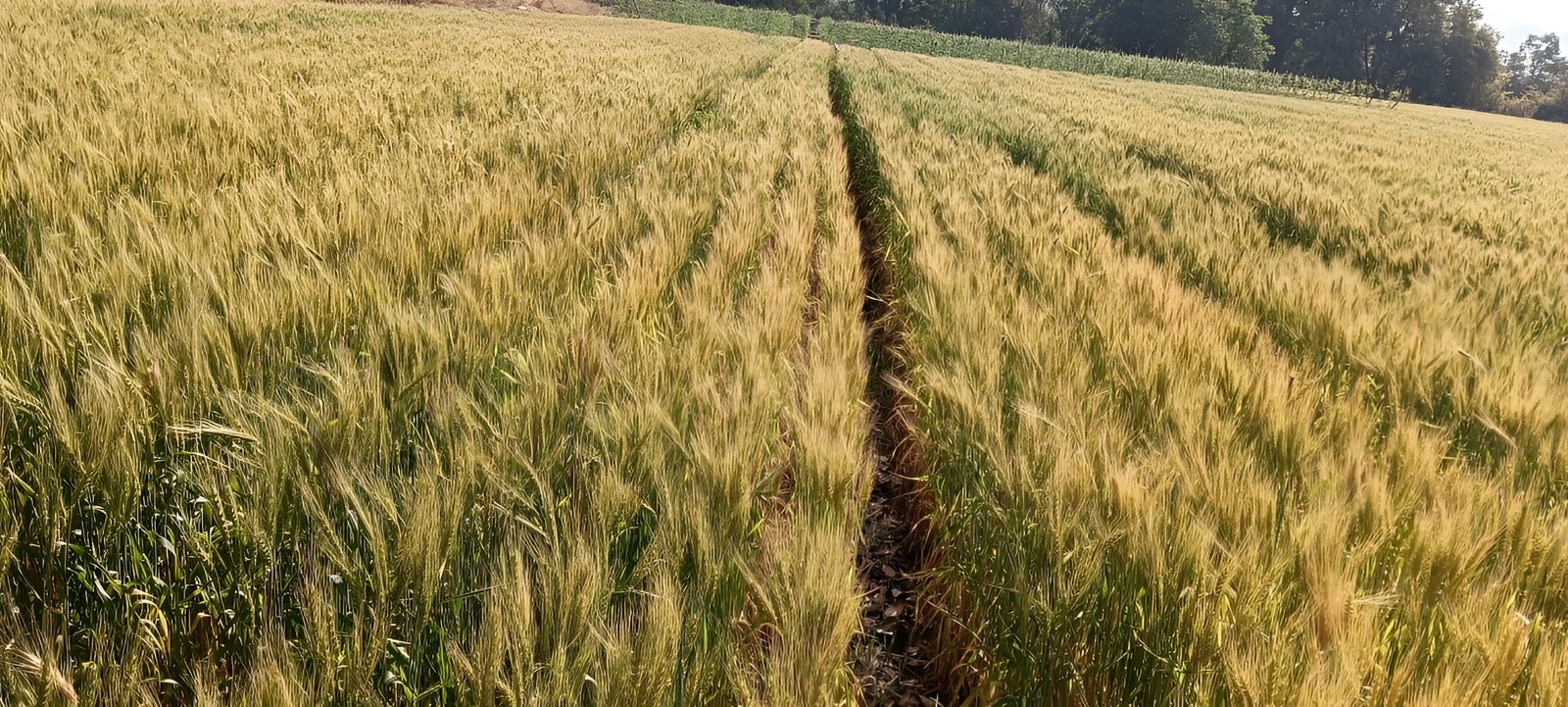
Mr. Bajirao Eknath Nathe, a tribal farmer from Takeghoti in the Igatpuri taluka of Nashik district, has 1 hectare and 10 gunthas (approximately 2.75 acres) of agricultural land. For the past eight-nine years, Mr. Nathe has been cultivating this land using the Sagunaa Regenerative Technique (SRT), primarily growing crops such as rice, wheat, chickpea, groundnut, and various vegetables. Under the SRT cultivation, the soil is tilled only once; subsequently, during the Kharif season, raised beds of 2.5 to 3 feet in width and 1 feet in height were prepared on the tilled land and various crops are grown on the bed in both Kharif and Rabi seasons. Naturally, as Mr. Nathe’s land is in a high-rainfall zone in the Igatpuri taluka, he plants rice saplings on these raised beds during Kharif season and taken rice production and subsequently, during Rabi season, he used to cultivate wheat, chickpea, groundnut, and other vegetable crops.
Last year, following the rice harvest and without undertaking any form of soil tillage, he cultivated wheat on a 50 Guntha (1.25 Acre) plot on November 28th. Utilizing the residual soil moisture, he employed the dibbling method for sowing, using 30 kilograms of seeds procured from a private company. Within 48 hours of sowing, he sprayed a herbicide mixture consisting of 15 ml of Oxyfluorfen, 150 ml of Glyphosate and approximately 100 grams of Urea.
Approximately 12 days after the wheat had sprouted, 50 kilograms each of 20:20:00, 15:15:15, Super Phosphate and Urea fertilizers were mixed together and broadcasted in the field followed by irrigation.
30 days after planting, a second application of fertilizers consisting of 50 kilograms each of DAP, Urea, and Super Phosphate, along with 10 kilograms of Zinc Sulphate was applied. The crop was irrigated for the second time using a raingun.
Subsequently, on the fourth day (while the soil was still moist), the herbicide Metsulfuron-methyl was sprayed on the land.
On the 52nd day after planting the wheat crop, another round of fertilizers comprising Urea, 12:32:16, Zinc Sulphate (10 kilograms) and Boron-enriched Super Phosphate (one bag) was applied. The crop was irrigated using the flood irrigation method (within the channels between the raised beds).
5 days later (on the 57th days after planting), a mixture consisting of 300 grams of fungicide powder, 300 ml of insecticide, 1 kilogram of 13:40:13 water soluble fertilizer, and 500 ml of Gibberellic acid diluted in 200 liters of water was sprayed on the crop.
Zinc phosphate was applied twice to control rats.
On the 75th day, flood irrigation was provided once again.
While the grains were filling within the earheads, a combination of 3 kilograms of 19:19:19 fertilizer and 150 grams of Boron mixed in 200 liters of water was sprayed on the crop.
The final irrigation was provided to the crop on the 87th day after planting.
After 113 days (on March 20th) a harvesting machine was used to harvest and thresh the wheat crop. From an area of 1.25 acres (50 Gunthas), Mr. Nathe obtained a yield of 20.60 quintals (41.20 quintals per hectare).
Based on a market price of ₹3,400/qntl, Mr. Nathe generated an income of ₹71,400 from the wheat produced on the 1.25 acre plot.
For adopting SRT technology, Mr. Bajirao Nathe received valuable guidance from Mr. Chandrashekhar Bhadsavale, Founder of Saguna Rural Foundation, along with Mr. Anil Nivalkar and Mr. Parashuram Agivale, from Neral; Additionally, from Nashik (on the request of Mr. Nathe) I too provided useful guidance regarding wheat cultivation time to time.
Mr. Nathe states that, “by using the SRT technology, the fertility of his land is enhanced and improved its soil structure. Furthermore, the population of earthworms and other beneficial micro-organisms in the soil has also increased.”